‘Think Like A Scientist’ is a course designed to improve critical thinking and encourage independent thought for students in any educational environment. We use adaptive education practices to increase accessibility to science education.
Thanks for stopping by! We are a collection of educators trying to make science more accessible. We run science outreach programs but also train graduates to be more accessible in their science communication.
Here is a short film about us (2024):
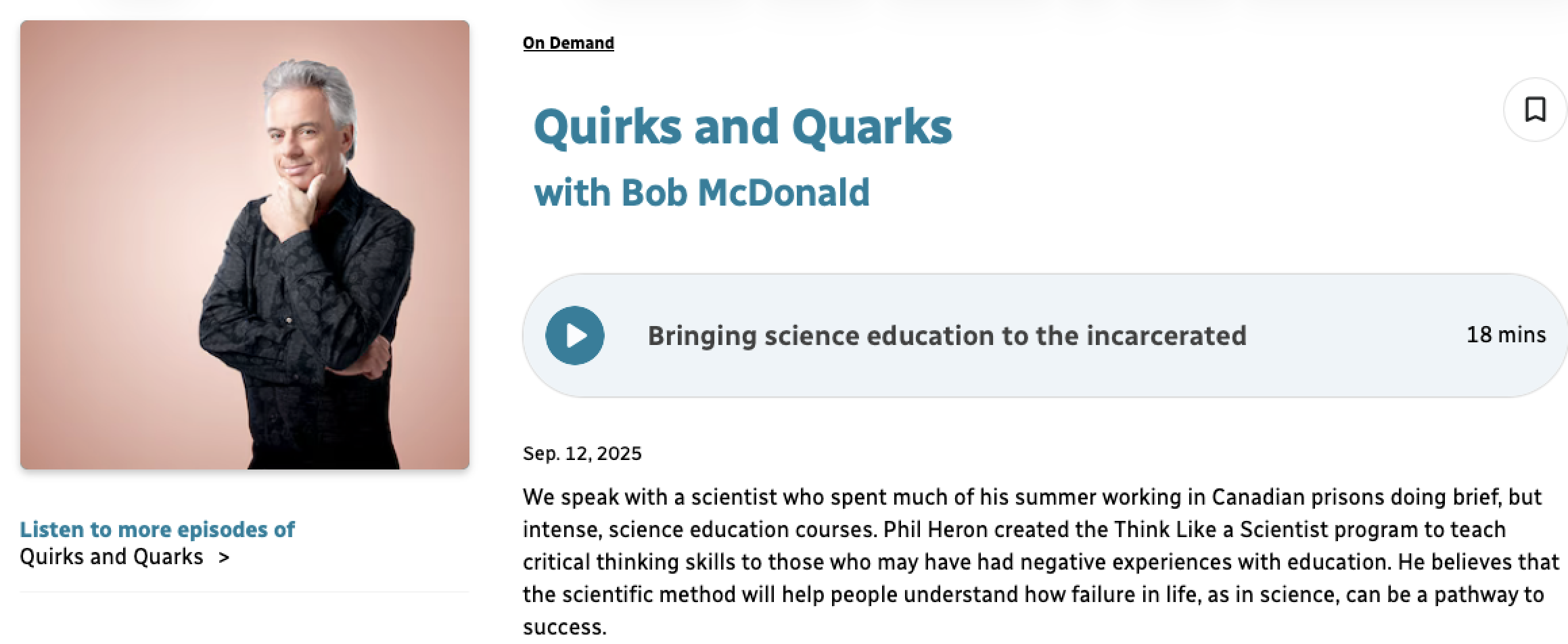
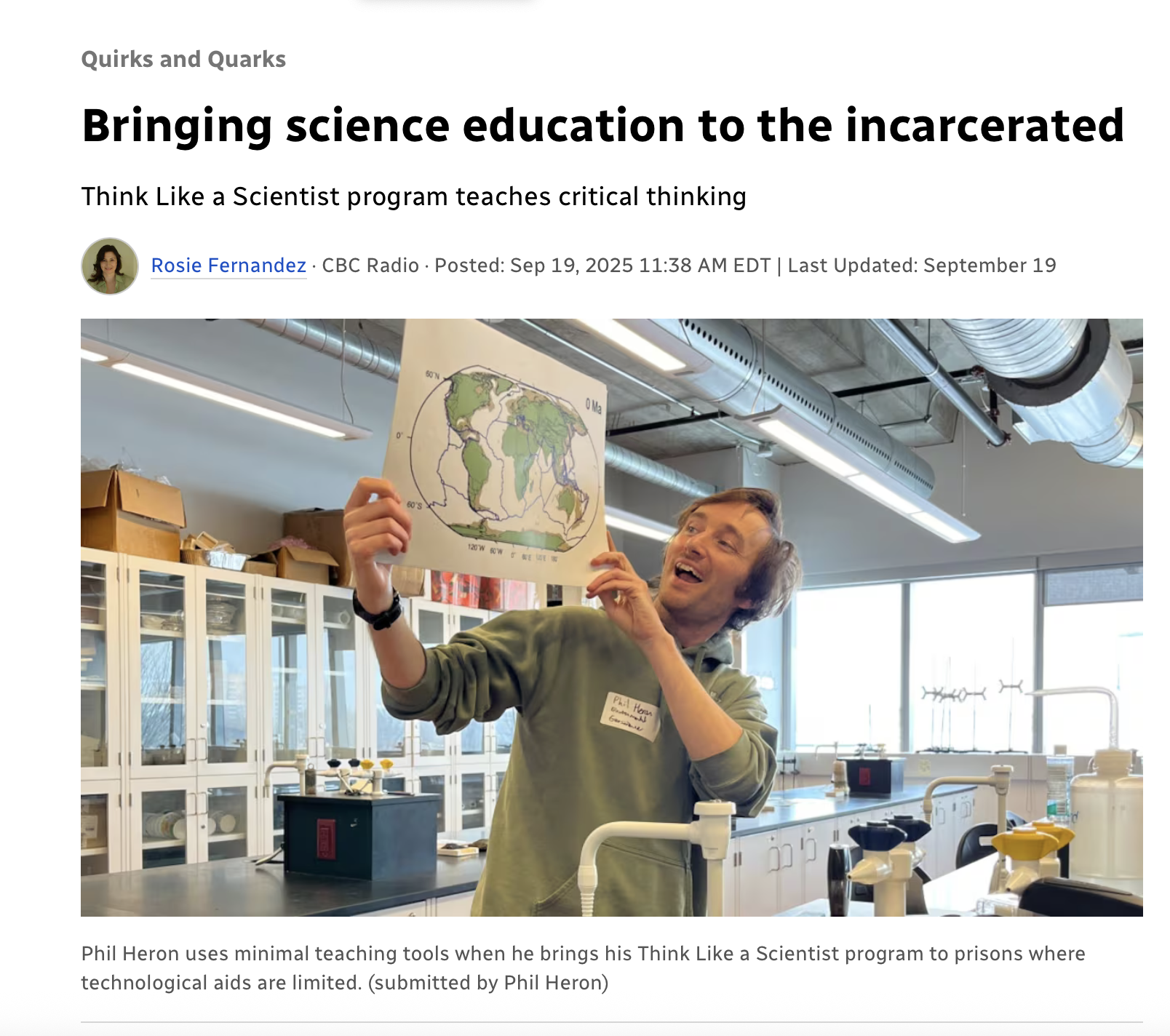
In 2025, CBC Quirks and Quarks did a feature on our work, shown here in a blog post and 18 minute audio clip – check out our segment here!
Why do we do science outreach?
Science, technology, engineering, and math (STEM) subjects have historically struggled to be inclusive and accessible to students from diverse backgrounds. STEM subjects at school and university have often been rigid in their teaching structure, creating barriers to education for students with more specific (or unrecognised) learning needs.
Furthermore, exciting and important science topics (such as climate change and space exploration) are often communicated in a way that reinforces these barriers. To discuss these issues, and to combat such barriers to education in academia and in the public, I have been working on creating accessible science frameworks for researchers and educators – in the form of the course and workshop Think Like A Scientist.
Think Like A Scientist started in 2017 in the English prison system and has recently featured in prisons in Australia (2024-2025), Spain (2025), and Canada (2023-present). However, we have run the courses in other settings, including schools, adult learning facilities, and youth work (both online and in person). The success of the course is based around the creation of a classroom dynamic that is accessible, inclusive, and relatable to students from all backgrounds.
Fundamentally – science is for everyone.
And in today’s world, it is extremely important to be informed.
Think Like A Scientist is run by Phil Heron (University of Toronto Scarborough). We have a number of colleague we work with, if you would like to work with Think Like A Scientist please get in touch.
Science communication workshops and research
As well as science outreach programs, we also run science communication workshops where we share what we have learned from teaching science in restrictive settings. If you are a scientist who wants to learn more about how we try and create inclusive and accessible science – whether in publications, or conferences, or talking to our parents – please get in touch.
Some of our research papers outlining our philosophy are here:
- Heron et al., 2025, Art, music, and play as a teaching aid: applying creative uses of Universal Design for Learning in a prison science class. Front. Educ. 10:1524007. doi:10.3389/feduc.2025.1524007
- Yin et al., 2024, Changing your perspective: the impact of different visualisation methods on seismic hazard maps. Canadian Journal of Earth Sciences. https://doi.org/10.1139/cjes-2023-0123
- Heron et al., 2023, Student perspectives on creating a positive classroom dynamic: science education in prison, Research for All, https://discovery.ucl.ac.uk/id/eprint/10175269/
- Heron and Williams, 2022, Building confidence in STEM students through breaking (unseen) barriers: Geoscience Communication, 5, 355–361, https://doi.org/10.5194/gc-5-355-2022
- Crameri et al., 2020, The misuse of colour in science communication. Nat Commun 11, 5444 (2020). https://doi.org/10.1038/s41467-020-19160-7
Overview of our science outreach program
Through dialogic teaching methods and guided by a critical thinking framework, our students are taught to analyse research and feel connected to the outside world through learning about space missions, climate change, natural hazards, the Universe, the science of sleep, and artificial intelligence.
In a world where ‘fake news’ is a real danger, the course offers students the basic building blocks required to think like a researcher, guided by the scientific method as a tool to gain understanding (e.g., what are we trying to find out? how do we test that? can we confirm a result? what else do we need to know to be sure of our findings?).
We work from a version of the scientific method:
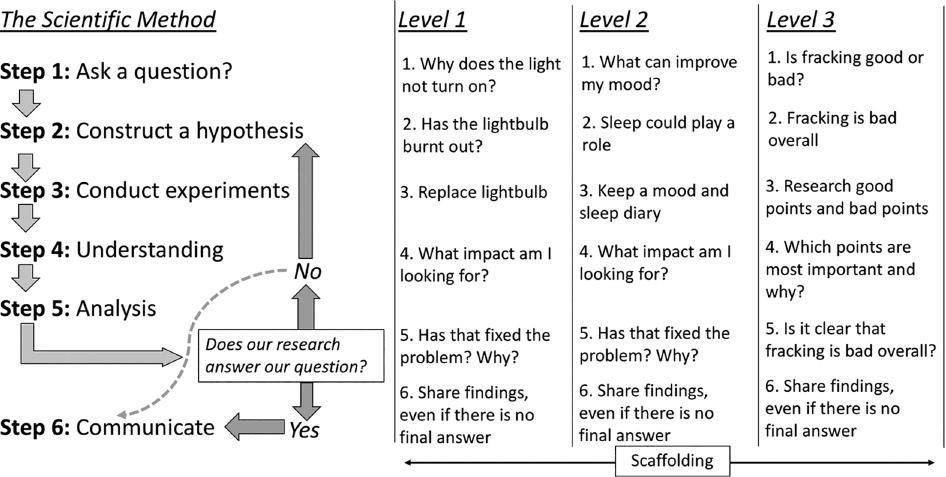
A major part of science is failure – we only do an experiment because we do not know the answer. In Think Like A Scientist we normalize failure and work to build forward.
Presently, being a scientist is a lot more than testing a hypothesis – you are required to be able to understand how robust your findings are through data analysis, and also be able to present your work in a clear and concise manner. Think Like A Scientist teaches the students how to use the scientific method alongside applying analytical and communication skills.
Think Like A Scientist has been running in a number of English prisons since 2019, and has recently featured in Australia (2024-2025), Spain (2025), and Canada (2023-present). However, courses can by tailored to suit the specific needs of the students and we have ran in many different environmental settings (schools, adult learners, etc) – please get in touch if you would like to collaborate or learn more.
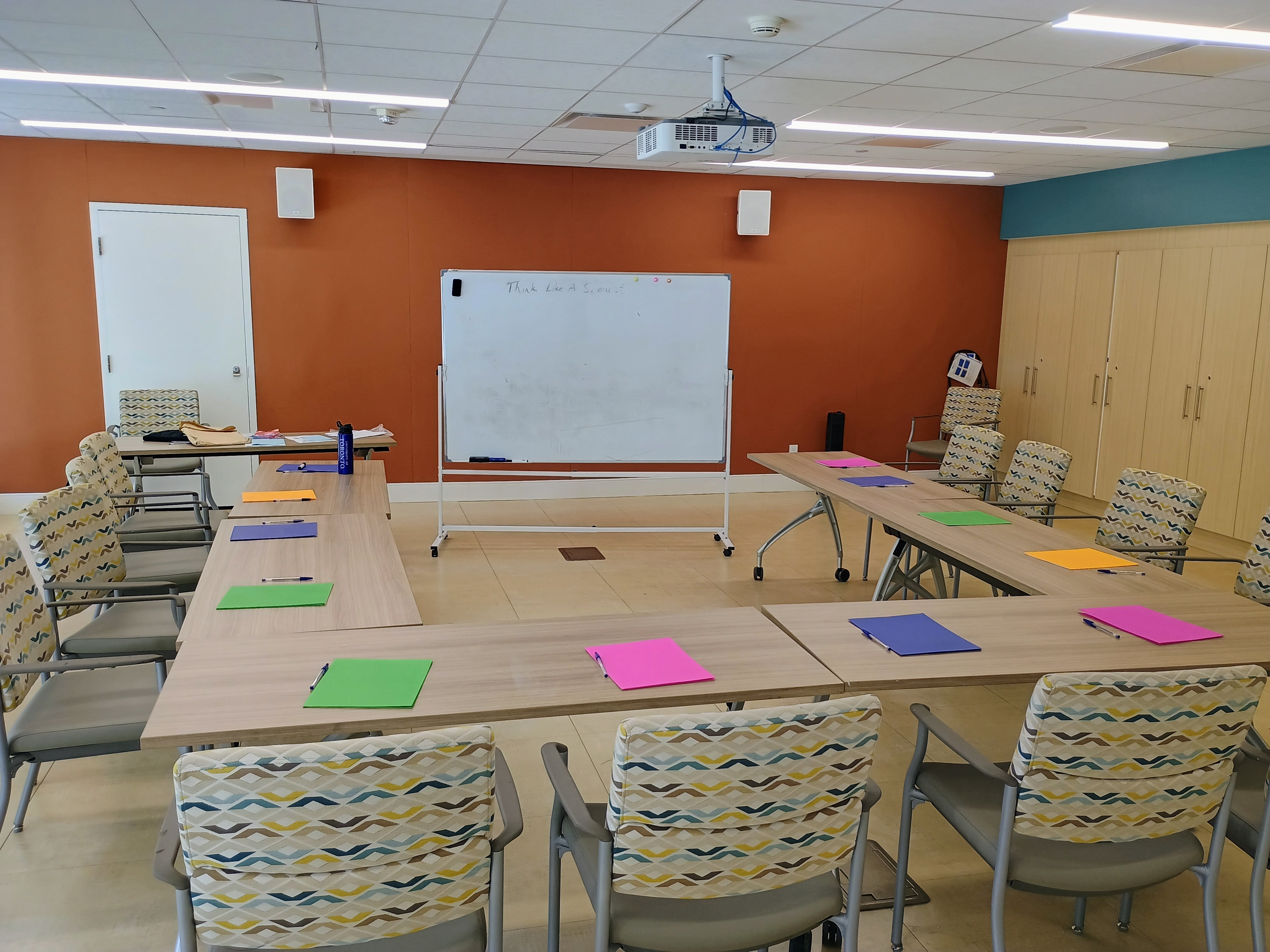
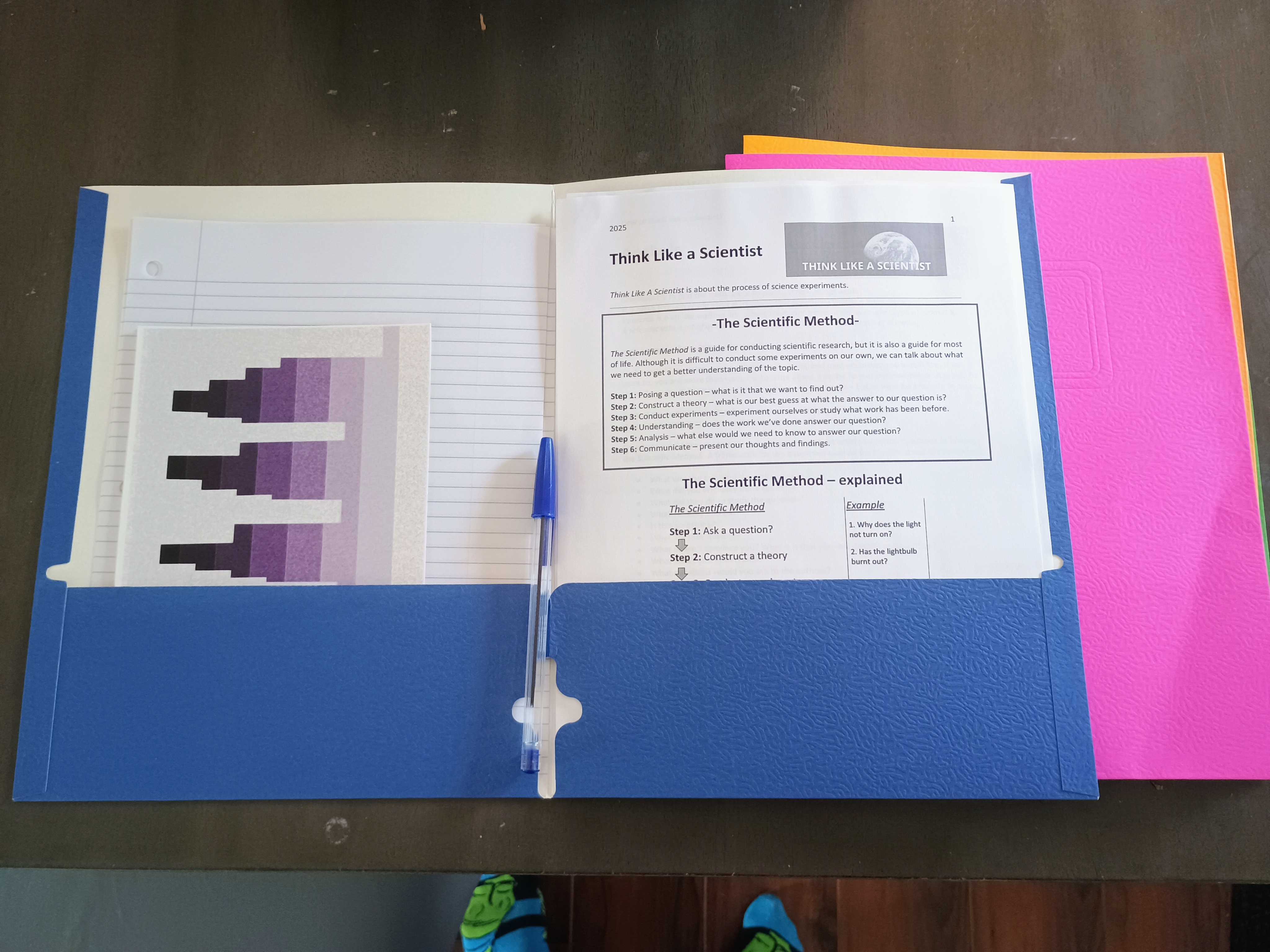
Colleagues


Awards, Posters, and Feedback
Think Like A Scientist has been featured in the following awards:
- EGU Public Engagement Award winner (2019)
- Featured as part of Durham University’s Excellence Awards
- Shortlisted for an Impact and Engagement Award at Durham University for Think Like A Scientist
- British Geophysical Association outreach Award winner
- N8 New Pioneer in recognition for the exceptional education performance of the Think Like A Scientist course
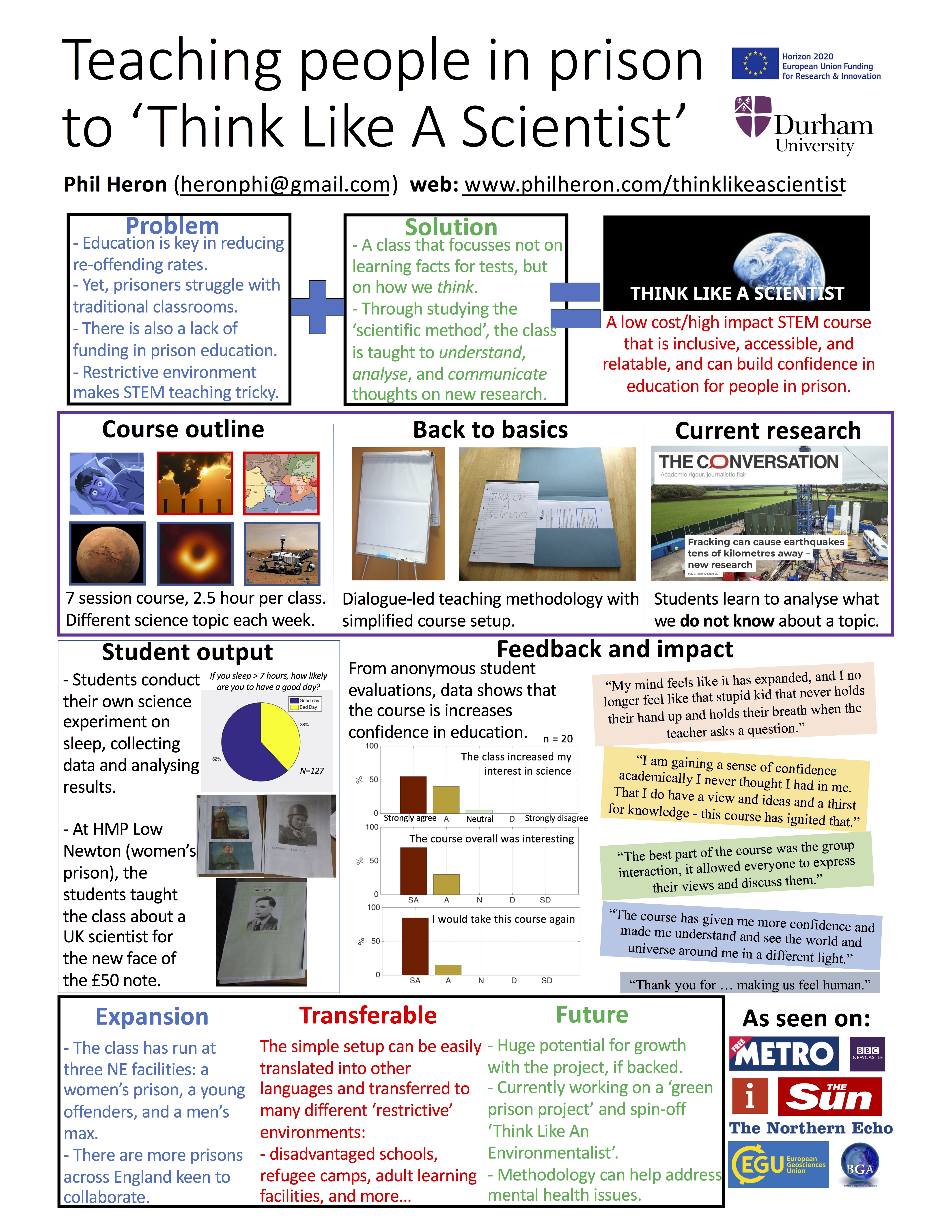
- shortlisted for the STEM for Britain awards. In 2020, Think Like A Scientist was selected to be presented to MPs in Parliament due to its impact on students. This was a nationwide competition, with the final presentation at the Houses of Parliament. STEM for Britain is described as “major scientific poster competition and exhibition which has been held in Parliament since 1997, its aim is to give members of both Houses of Parliament an insight into the outstanding research work being undertaken in UK universities by early-career researchers.”
A alumni of the course has written about his experience in this article – link here. However, a favourite quote is as follows:
“Science taught me about a world I had never felt a part of because I didn’t understand it. Science taught me to connect ideas, take notes, create plans, and figure out routes; it showed me that scientists will take a chance and if it does not work out, they will find another way, and another way; that you can build ideas through other people’s work and add on, develop, team work, build on failure as an achievement; but above all, learn to keep going forward.”
Dalton Harrison
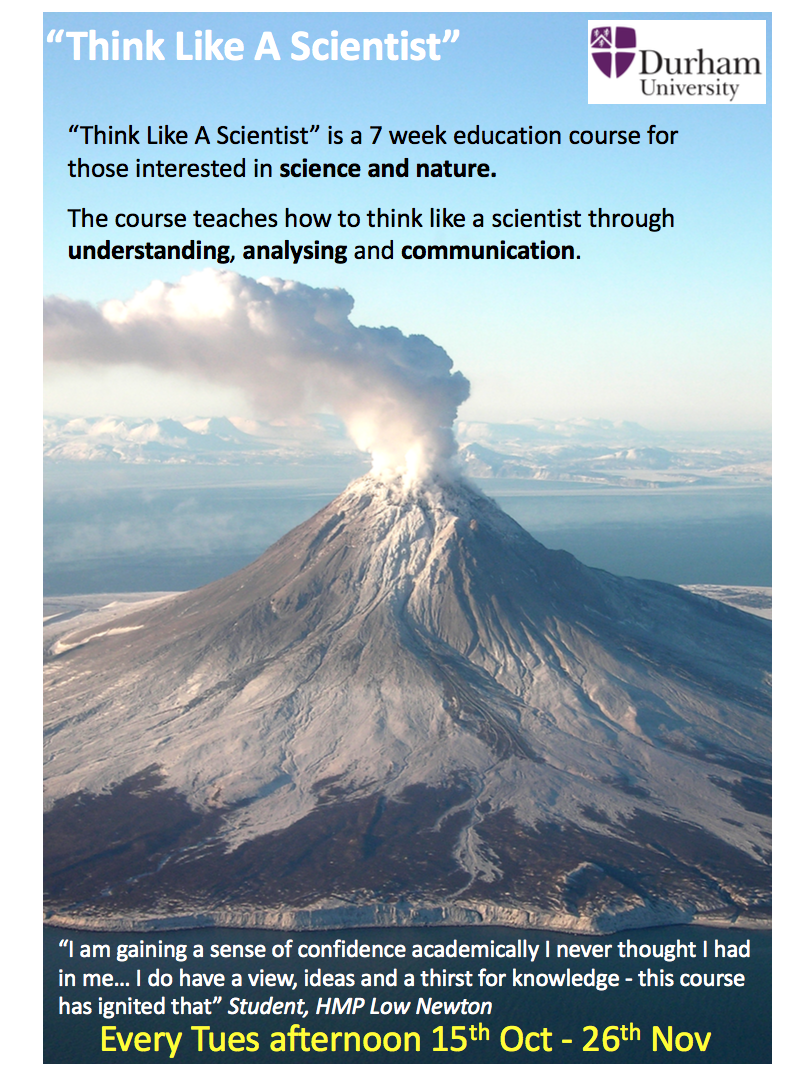
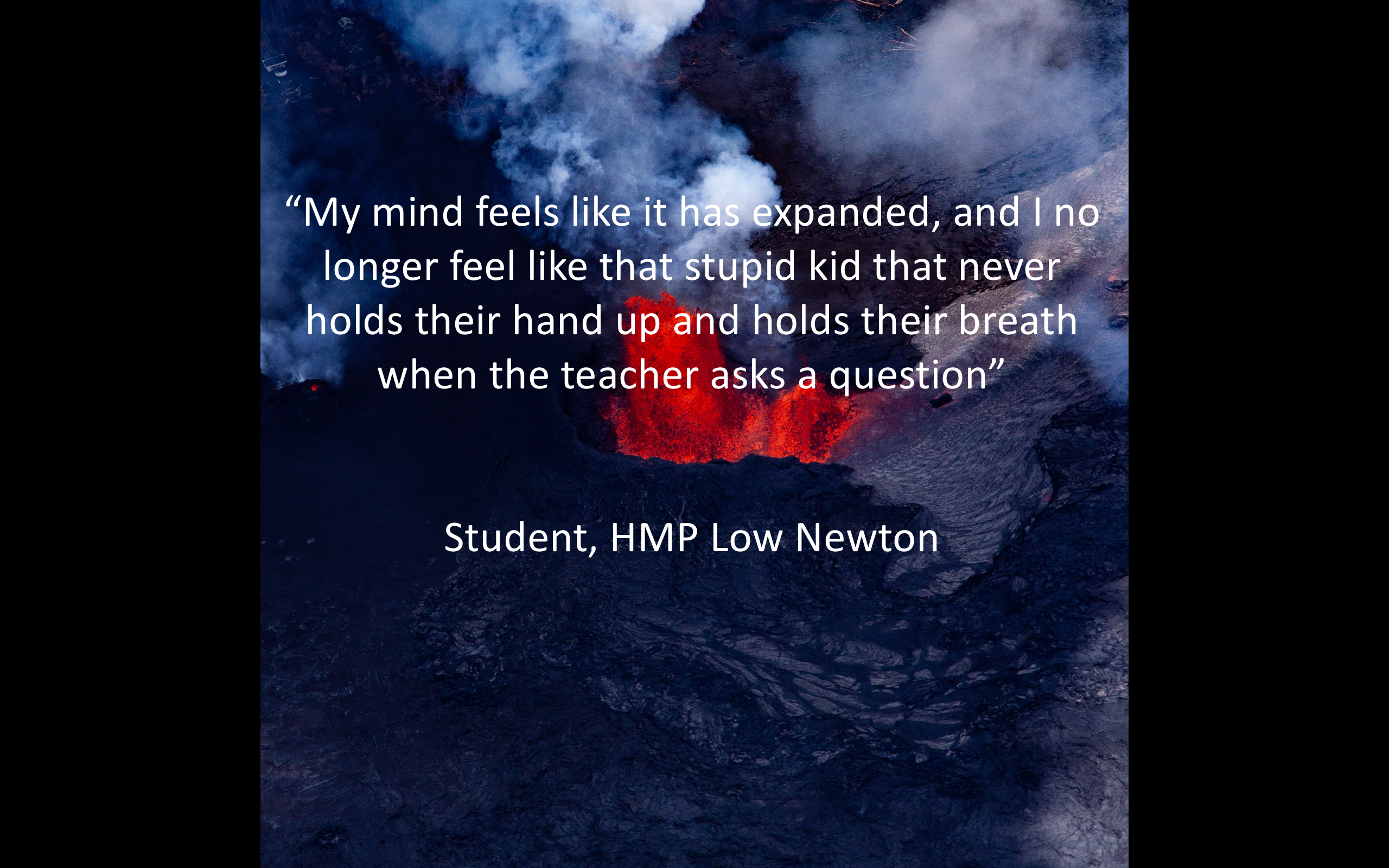
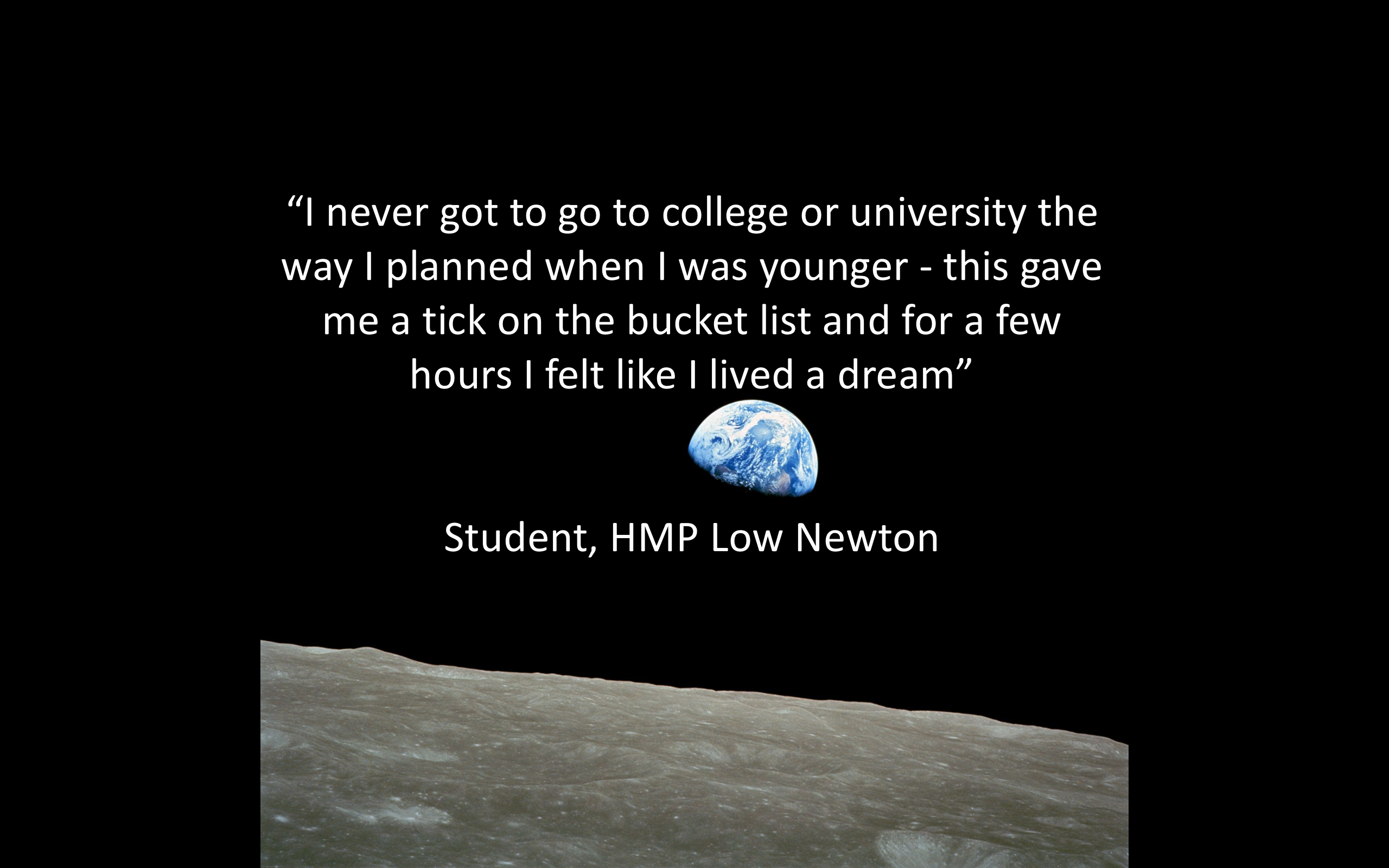
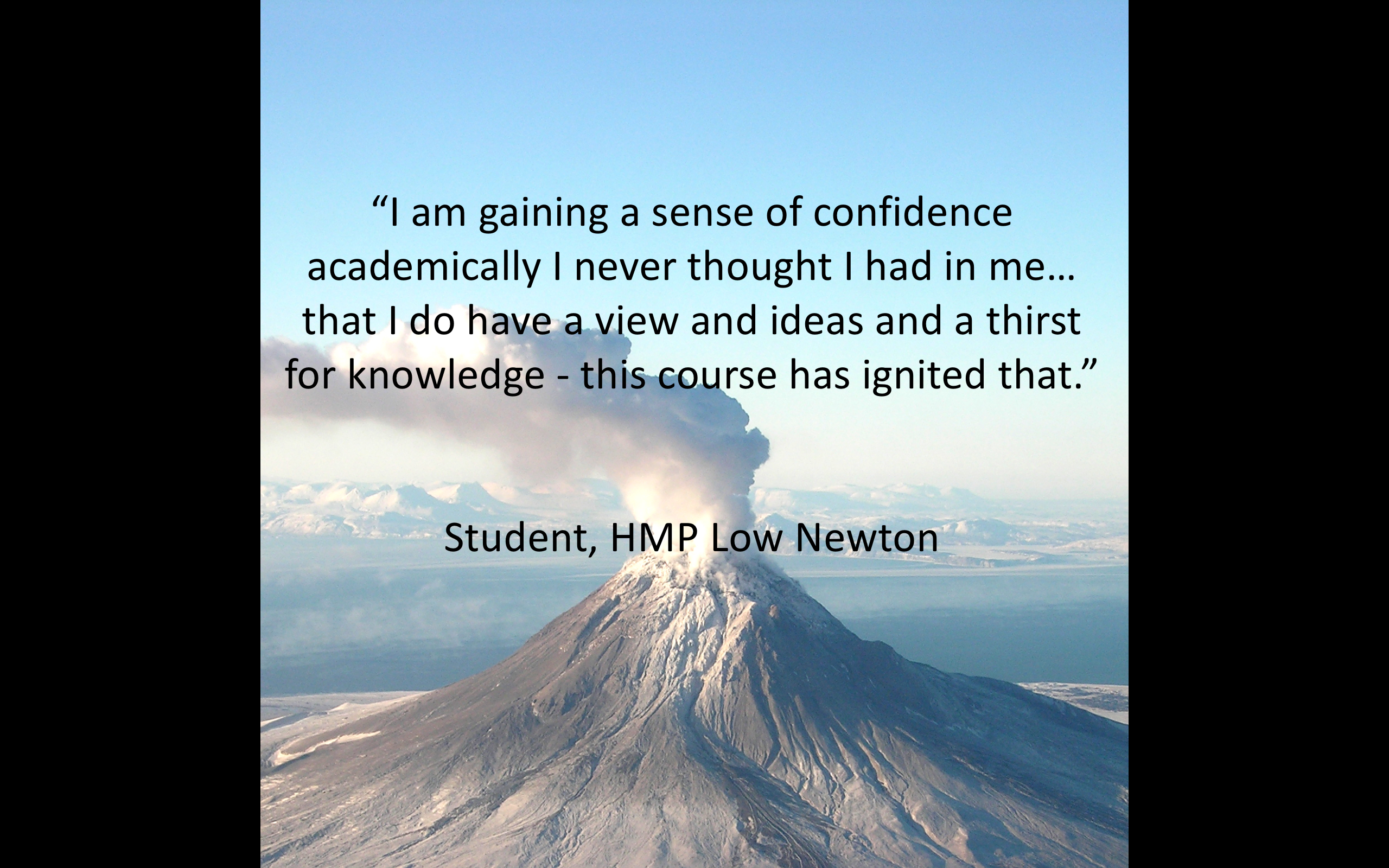
A selection of posters and feedback is shown here:
Media
Media attention for Think Like A Scientist:
CBC Quirks and Quarks – September 2025
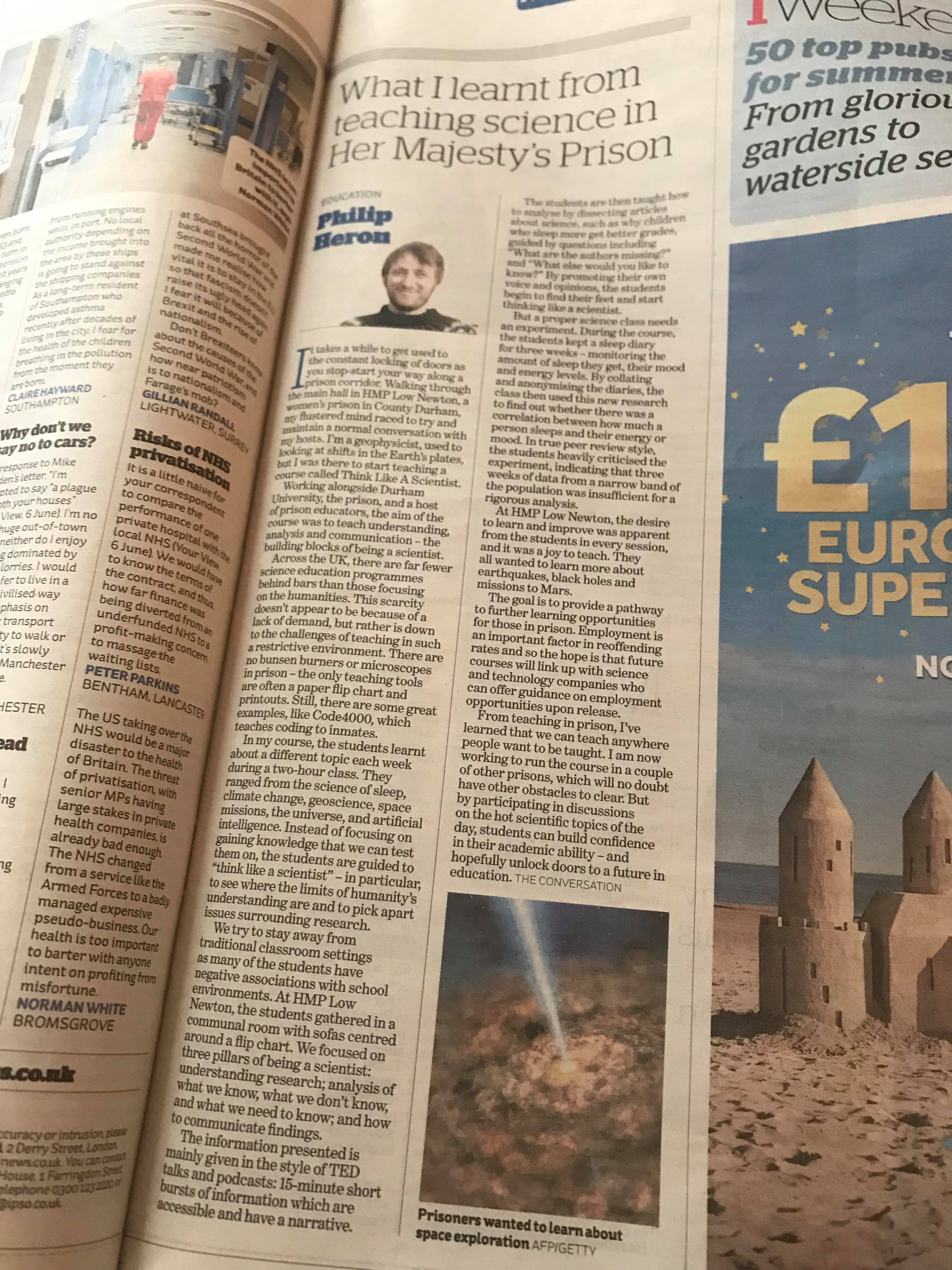
The Conversation – What I learnt from teaching prisoners to think like scientists
BBC Newcastle – 15th May 2019 (51 minutes in, and 1 hour 50 minutes in)
Durham University website – 15th May 2019
Durham University News – 15th May 2019
BBC Radio Tees – 15th May 2019
EGU Outreach Award – 8th April 2019
The Sun newspaper
Promo video from 2019:
Partners
Think Like A Scientist runs in partnership with:
European Union’s Horizon 2020 research and innovation programme under the Marie Skłodowska-Curie grant agreement No 749664.





Thanks
Think Like A Scientist would like to thank:
Paula Street
Durham University Inside-Out Prison Exchange Program – in particular Dr Hannah King
Cell Block Science – in particular Dr Mhairi Stewart
The Inside-Out Prison Exchange Program
HMP Low Newton’s Learning and Skills Manager Marianne B & Sarah B
Prof Tony Key (University of Toronto)
and:
Anna and the Durham County Council Libraries,
 Phil Heron